Showing posts with label disney. Show all posts

Saturday, 3 December 2016

ONION SKIN PRESENTATION

so basically this is how my presentation would have gone today if I had been there:


Onion skin paper was first used by typewriters alongside Carbon paper
Its strong and lightweightUsed in a variation of art sectors such as…This is because of how versatile it is.   Disney was not the first animator, he only introduced onion skinning in traditional animation in the 1920’s and  made his first historical leap in 1932. Rubbish.


People began using onion skin paper in animation around the 1900’s just after the creation of Celluloid paper by H.W Goodwin. - Celluloid paper was made from Gum cotton and Camphor.
Emile Cohl created Fantasmagorie in 1908 and created what is now known as the ‘first true traditionally hand drawn animation. She used onion skin paper, to draw and each frame before shooting them onto negative film. - 700 drawings long just fyiThe lightbox was introduced in the mid1800’s to photographers but only taken up almost half a century later by animators. Emile Cohl did use it for Fantasmagorie but many didnt use a light box or light table till much later.Max Fleischer began experimenting with the lightbox in 1915, creating the rotoscope device. Consisted of a single light source, plexiglas and a projector with a lense. All attached to an easel. 


1971 was the start of digital animation, when peter Foldes created Metadata, drawn on a tablet invented by Ivan Sutherland in 1962 on software developed by Nestor Burtnyk and Marceli Wein designed for  computer assisted keyframing. This was the introduction of digital onion skinning.  This was the most primitive of stages in digital animation, John Whitney introduced inbetweening into computer animation but was limited to vector based, single outlining animated drawings.Alan Kitchings introduced solid colour inbetweening in the 70’s animation Antics.
Implicit curve oriented inbetweening is a piece of software that basically predicts the movement of an object between key frames in order to in between for you - computer generated inbetweening speeds p workflow and eventually leads to auto-painting algorithms which is actually available in tv paint, but its slightly rubbish as its a generalised algorithm. Auto painting algorithms work on a bucket-fill basis only, and do not work for shading . but MFBAs have improved the innacuracies atleast by inputting further developed mechanisms. Linear interpolation is shown in the second image with four examples, they all follow the same 4 rules:1 smooth motion2 edges and curves all remain as smooth as provided on the keyframes
3 size and stylisation is dependent on the inbetweener4 curvature of strokes change between keys but dynamics of each curve and line must be taken into consideration. So a shows the basic linear interpolation,b is feature based stroke interpolation of a, c has montion enhances interpolation based on b, and d is path driven in betweening based off c. 


The Paperman Method takes computer generated inbetweening to the next level, combining 3D rendered animation with 2D drawings. It removes any questions of perspective, sizing, shapes, and motions. All the 2D inbetweening is still computer generated, by the Key framer, and can be edited on a computer, live, instead of redrawing frames. The Paper Man method does involve the use of Meander.


Meander uses vector curves …. FERN!!!!


While 2D animation is the ‘classic’ and everyone remembers the Mickey Mouse classical animations, current productions has surpassed this, in a technological sense and in a been there done that kind of way.  Artists are advancing with the technology available, things like the original Disney movie Snow White seems old fashioned in comparison to present day features. 2D will always live on in TV cartoons for younger audiences, but the use of 2D animation no-longer lives on the big screen. Everyone remembers the scene in ‘Frozen’ where Elsa creates her ice kingdom using computer generated fractals, this is something 2D animation just cannot replicateThere are always hopes to further the 2D side of animation without converging into 3D and this results in the 2D/CG hybrids, which Paperman was constructed upon.

Tuesday, 18 October 2016

Pick n Mix Project (Instalment no. 6 - we bear bears)

SO

i started with character designs after the animatic went horrifically wrong... but before the final animatic... if you can be bothered to watch them.. youll see his character changes half way through one of them and stays that way from then on... So basically... i went for three designs after trolling through google images for what felt like an hour, looking for some inspiration. 
bear no.1 was a design from the teddybears made during the art nouveau period (kind of fluffy, moving joints, human like stature, beer belly, glass eyes)
bear no.2  bear no. 2 is kind of a take of from Disney's Brave, but smother with fur, short arms and big claws, which i though could be funny, animating him scraping claw marks into the panel desk or cutting through the back drop...
and  bear no.3  was a mix between the two but with pointier ears, shorter less promenant muzzle, shorter arms, mid chubbiness, and shorter rounder claws


i think no. 3 won... and i continued to use him for the animatic. he seems smoothest, curlier, and i thought could draw him in photoshop in like 20% opacity and under animation have a texture background so when he moved the pattern changed, if you get that idea.. Ill probably do a text animation if i get a chance from the other impending projects.


Friday, 14 October 2016

Pick n Mix Project (Instalment no.3 )

I spent the last 24 hours in the studio around lectures and seminars all that boring stuff redoing the storyboard, and for a very good reason. I had a dream about ted the teddybear doing a sketch called Singing in the rain. and thats where the 'meets james corden' from the previous instalment comes in...


so all that was the stuff you saw before basically with some stage directions and an extra frame for the intro.... I took out the basic camera shots because i can't really plan that until the audio is recorded... but then... i did this.. and the backgrounds took the majority of the time tbh... so... we have no1 the ceramic woman doing 'Goodmorning Baltimore' from Hairspray  infant of the New Amsterdam Theatre - and if you read any of the research i posted (don't worry i don't expect you to have) then you'll know that the New Amsterdam Theatre is a Building in Manhattan, just off Times Square, built in 1902-3 and was designed by the architecture firm of Henry Hertz and Hugh Talland. The Building was used as a movie theatre in the beginning of 1937 and closed in 1985. It was then leased by Walt Disney Co. and renovated in 1995-7 to be the flagship of Disney Theatrical Productions presentations on Broadway -  how cool is that! 

I was originally going to do her singing Taylor Swifts 'Love Story' as it includes a reference to Romeo and Juliet... and .. therefore shakespeare but i thought it was too much of a leap... so i just went with the whole Broadway thing...

The Second background was an art Nouveau style sky, with simply just clouds and swirls and Art nouveau-esque style. I don't know...I thought it'd be funny to do the FBI version of I believe i can fly or... possibly the numa numa song ... 

next we have the Russian Doll named Ronda (or something) singing Vanessa Carltons' "A thousand miles'  just because id love to see her run with no legs or arms, her head bopping of with every bounding leap to see another doll inside... but then i might just be weird. 


And lastly we get to my dream of 'Singing in the rain by Ted the Teddybear (yes i see how childish that name is..)

but how brilliant would it be that a bear sings the song with top hat and umbrella!?

this would be scripted of course... but on the plus side.... reality tv is completely unscripted or atlas partially unscripted. 


Wednesday, 30 March 2016

Background Projects - layouts from disney


Lilo and Stitch - the Beach (1)

the background itself to around 8 hours, using photoshop and several layers. but the layout itself is quite simple in form yet effective. you have the foreground - the animating area, the mid ground is the sea and the background is the sky. the lines between the three different sections are quite distinct, in that the horizon meets the sea with a bright yellow, opposite to blue on the colour wheel and therefore creating the biggest contrast, while the sand is a blood orange, darker, yet still far enough from blue on the colour wheel to create a crisp line between the fore- and mid-ground.


 Alice in Wonderland - the White Rabbits Home. (2)

this was the only one of 5 which i created with pen and paper rather that digitally. i spent some time roughing it out in pencil and paper before pushing into the acrylic paint. the process was much longer than the digital pieces (mixing paint, waiting for it to dry before you can apply the next layer... you get the idea)  the layout is rather odd in this piece, the layout suggests the animation will occur in the mid ground, say a character running or walking from the door and up the stairs (or the other way around), just because of the line between them. there is no real background in this piece, but the foreground is most defiantly the area furthest forward including the rug and table, anything in front of the staircase. 


(images went missing sorry)

Mulan - Garden Temple (3)

the first image is the original, i semi traced this piece (the dog). this Disney background has a distinct mid- and back-ground but the foreground seems to have been cut out. the mid ground being the temple and Little Brother (the dog), and the background being, well almost everything in the second image below. the background as a whole leads your eyes up the stairs and into the darkness of the temple, but with the dog included, he becomes the focus - what with him being a character.


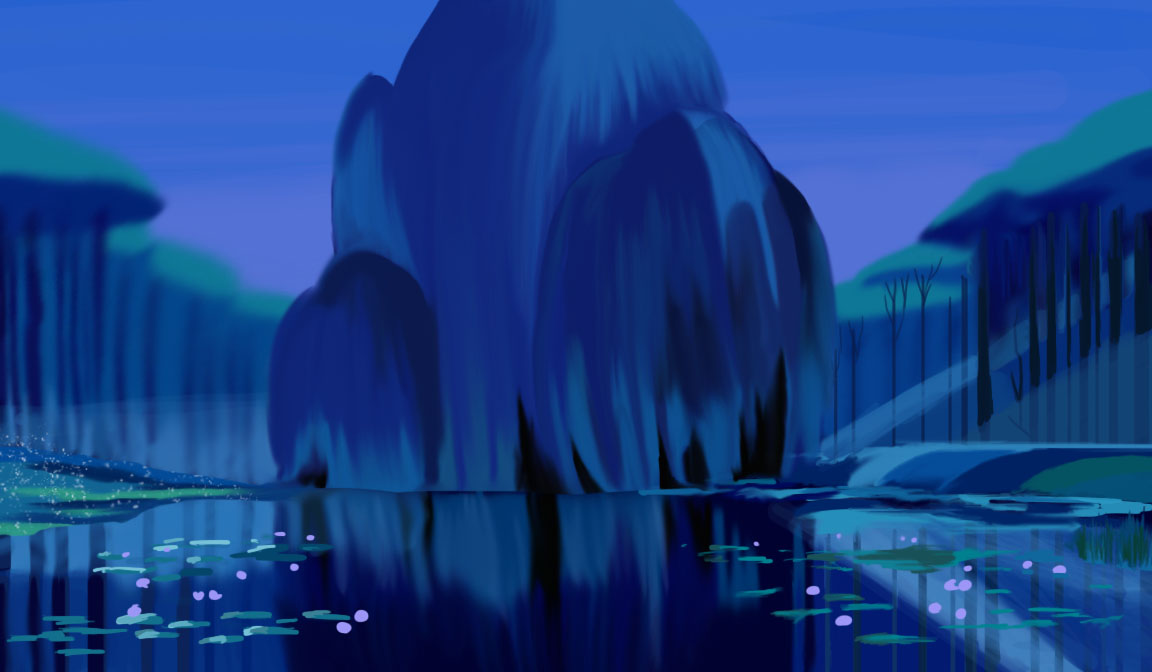
 Pocahontas - Some Tree Scene (4)

image 1 is my recreation of the second (original) image. as you will see from image 3, the foreground consist of the pond only, the mid ground included some of the pond as well as the weeping willow (which seconds as the focal point) and the banks. the trees on the sides, along with the sky make up the remaining piece -  the background. the trees on the edges are not only blurred to deter attention, but also descend in height - this is for two reasons, the first to aline with the vanishing point behind the centre of the weeping willow, and second, to guide the audiences eye to the willow tree. Even the light source on the right side of the screen and its reflection smoothly flow towards the focal point. 


Monday, 21 March 2016

Backgrounds from Disney


 so, Image 1 is the rough sketch, Image 2 is bold colours and some defined lines, image 3 contains more detail, and image 4 is the original disney snapshot.

Wednesday, 16 March 2016

Revamping Old Work

so for my Background project with Kathy, we have been set to spruce up some old work, stuff that could just use the extra touch since we've all been at university.

now i hadn't brought much old work with me, so i looked at an old sketchbook and found some drawings i did when i was rather tired and made them a little more proper:


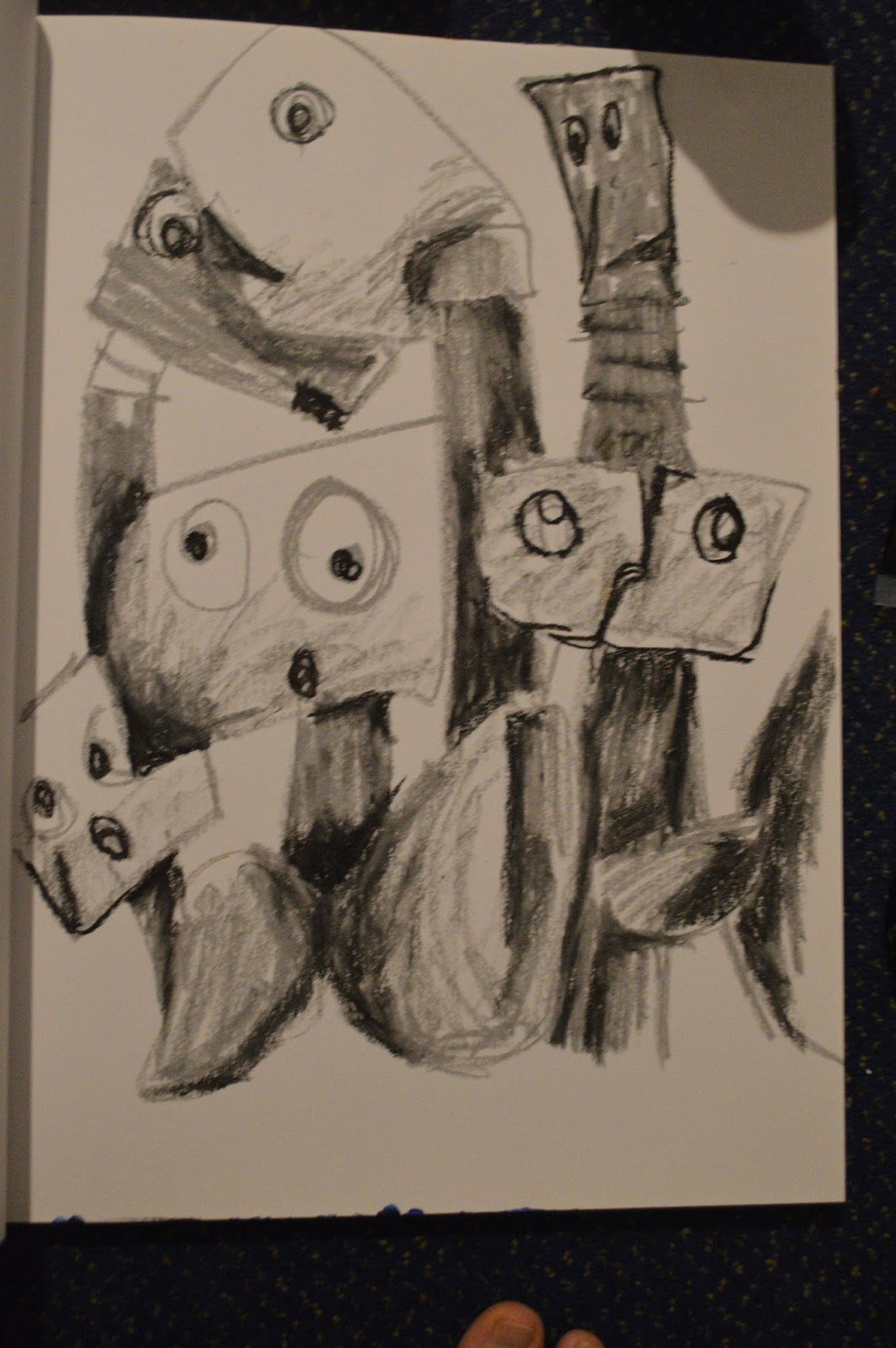
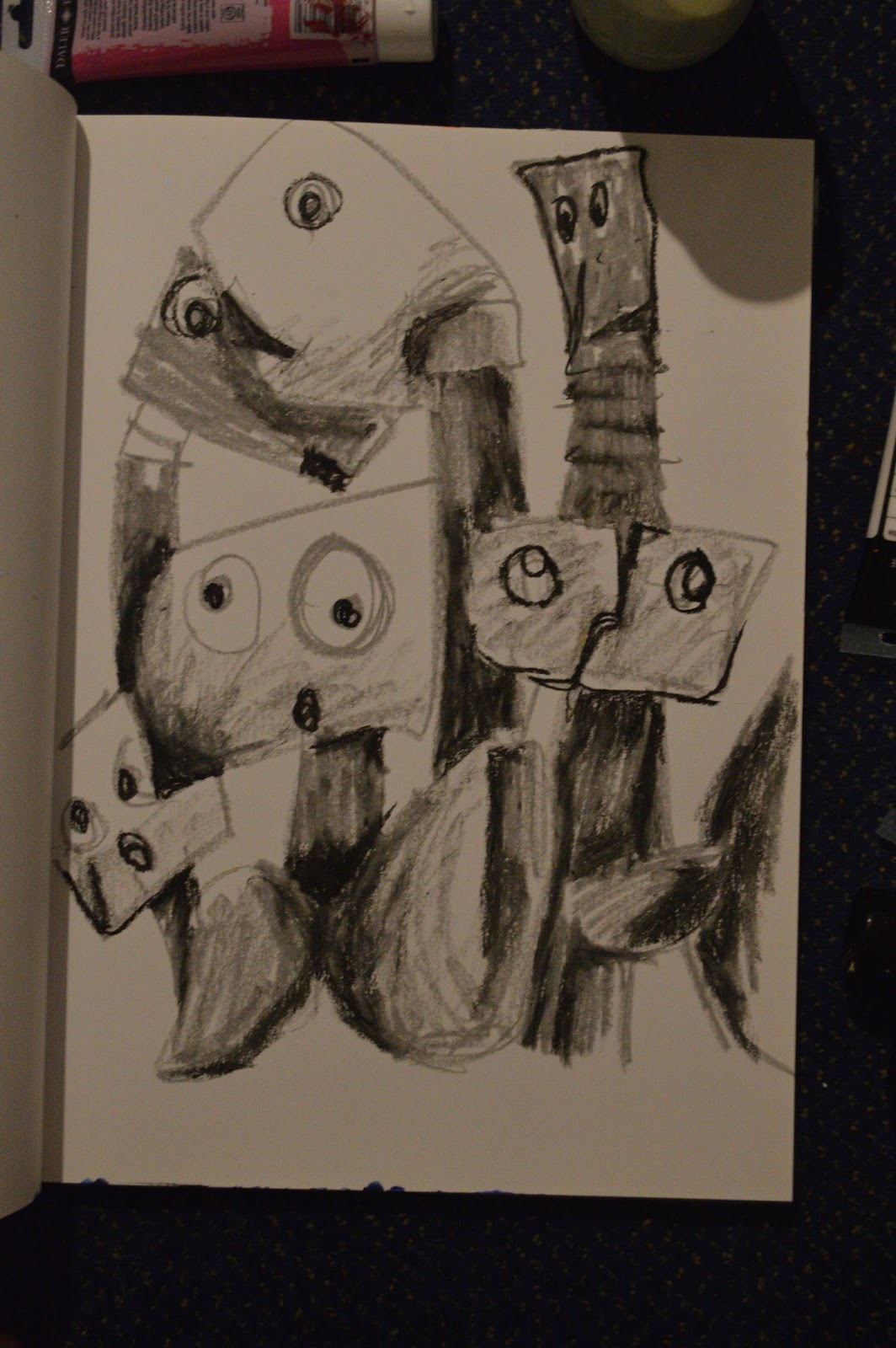
so above is Jaq from Cinerella, and below is a drawing of a sculpture from the Eden Project trip, both originally scrappy oil pastel drawings, but now transformed by acrylic paint.


New Website

New Animation Website